More than 60% of Indian enterprises with over 500 employees have deployed at least one AI-powered tool in their operations as of early 2026. Yet in most of these organisations, only a handful of people actually know how to use AI effectively. The rest are either not using it at all or using it in ways that produce mediocre results.
This gap is what AI corporate training is designed to close.
What is AI corporate training?
AI corporate training is a structured programme that teaches employees across an organisation how to use AI tools practically in their day-to-day work. It is not a general technology lecture or a demo of what AI can theoretically do. At its best, it is a hands-on session where participants work through real tasks from their own jobs using AI tools — and leave with skills they can apply the next morning.
The scope varies depending on the organisation, but most programmes cover:
- What AI tools are available and which ones are relevant to each role
- How to write effective prompts to get useful, consistent output
- Using AI for writing, research, summarisation, and reporting
- AI for presentations, communication, and knowledge management
- What not to share with AI tools — data privacy and responsible use
- Building habits that stick beyond the training session
Who needs it?
The honest answer is: most teams in India in 2026. AI tools have moved from experimental to mainstream, and organisations that are not actively upskilling their teams are falling behind competitors who are.
That said, some teams benefit more immediately than others:
- Marketing and content teams — writing, research, and campaign planning are transformed by AI. The ROI of training here is almost immediate.
- Sales and client-facing teams — email drafting, proposal writing, research on prospects, and presentation building all benefit significantly.
- Operations and admin teams — report generation, data summarisation, documentation, and process documentation are major time-savers.
- HR and L&D teams — job description writing, policy drafting, onboarding material creation, and training content development.
- Leadership and management — strategic analysis, briefing documents, meeting preparation, and communication drafting.
Many organisations assume only technical teams need AI training. In reality, the highest immediate ROI comes from training non-technical teams — because they have the most repetitive knowledge work that AI can help with, and they are the least likely to have explored it independently.
What a good AI training programme looks like
There is a significant difference between a training session that informs and one that actually changes how a team works. Here is what separates them:
- Hands-on over lecture-based — participants should spend more time using tools than listening. If there is no live practice, behaviour change is unlikely.
- Role-specific examples — a content writer and an operations manager need different use cases. Generic examples do not translate to real workflow change.
- Practical output from the session — participants should leave with at least one real piece of work they created during the session using AI.
- Resource pack to take away — a cheat sheet of prompts and tools relevant to their role, so they can continue independently after the session ends.
- Responsible use covered — what data should never be entered into public AI tools, how to verify AI output, and organisational guidelines.
How is it delivered?
Most organisations in India opt for live online sessions — they are easier to schedule, require no travel, and can accommodate teams across multiple cities in the same session. A typical programme for a team of 20-30 participants runs between 6 and 10 hours total, split across one full day or two half-days.
In-person sessions work better for organisations that want maximum engagement and have the ability to bring the team together. The hands-on dynamic tends to be stronger in person.
A good provider will do a pre-training assessment — either a short call or a participant survey — to understand the team's current familiarity with AI and customise the content accordingly. A team that has never used ChatGPT needs a different programme than one that already uses it daily but inconsistently.
What does it cost?
For a team of 20-30 participants in India, a well-structured AI corporate training programme typically costs between ₹40,000 and ₹80,000 depending on the scope, customisation, and whether follow-up support is included.
Compared to the cost of one employee spending 2 hours per day on tasks that AI could handle in 20 minutes — across a team of 25 people — the return on investment is straightforward to calculate.
Signs your team is ready for AI training
- Team members are spending significant time on repetitive writing or research tasks
- You have heard "I tried ChatGPT but the output was not that useful"
- Different team members are using different AI tools with no shared approach
- Leadership wants AI adoption but there is no structured rollout plan
- Your competitors or clients are visibly using AI in their work
- You have a new team or a growing team that needs to onboard quickly
Questions to ask a training provider
Before committing to any AI training programme, ask these:
- Will the content be customised to our team's roles and industry, or is it a generic programme?
- How much time in the session is hands-on practice versus presentation?
- What do participants take away at the end?
- Is there any post-training support if questions come up after the session?
- Can you share examples of what participants have built or created during past sessions?
A provider who cannot answer these clearly is likely running a generic deck-and-talk session — not the kind of training that produces real behaviour change.
Looking for AI training for your team?
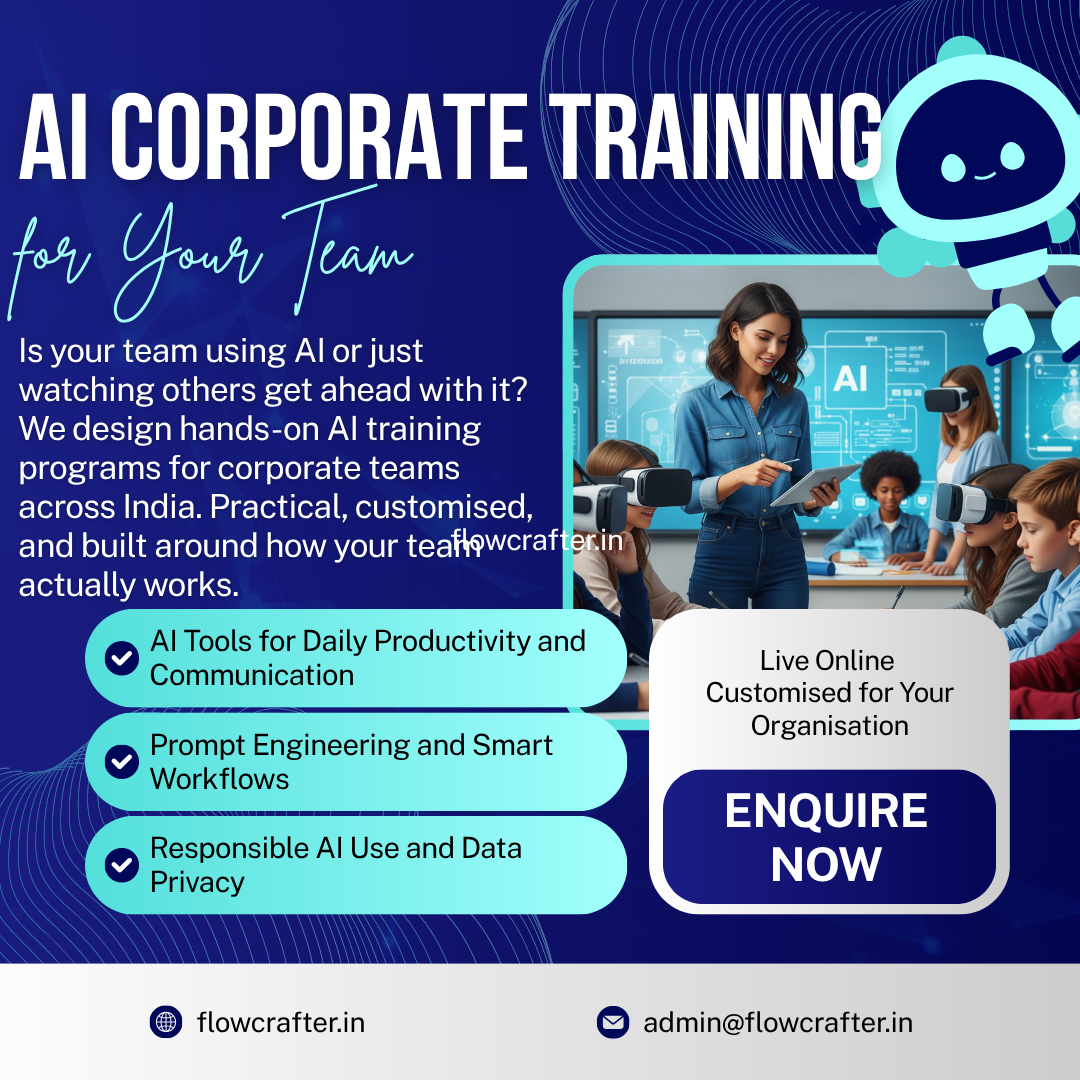
FlowCrafter designs and delivers practical AI training for corporate teams across India — fully customised, hands-on, and built around your team's actual workflows. Live online, any team size.
Talk to us about your requirements